Buy Vidalista Online
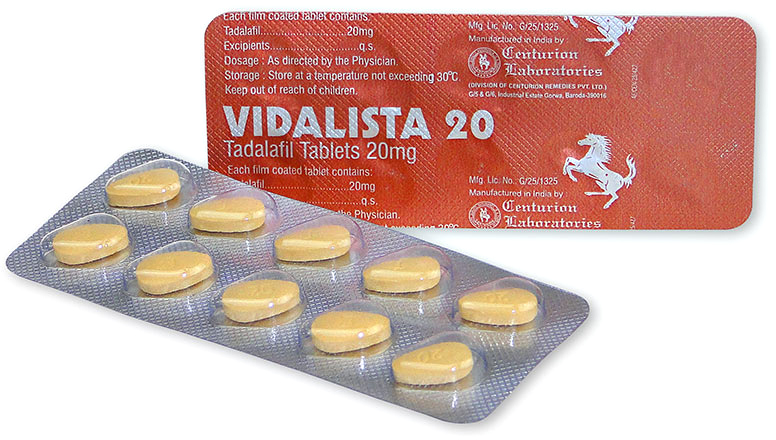
| Active substance: | Tadalafil |
| U.S. Brand: | Cialis / Adcirca |
| Indian Brand: | Vidalista |
| Mfd by: |  |
| Strength: | 20, 40, 60mg |
| Form release: | blister with 10 tablets |
| Shipping time: | 7 – 21 days |
| Best price: | 0.40 USD |
| Order: | through request form |
Vidalista 20 mg, is an FDA-approved medication used to treat erectile dysfunction problems in men. It’s the only medication proven to treat ED issues for as long as 36 hours. Vidalista 20 mg is manufactured by Centurion Lab in India.
We Sell Generic For Cialis from India – Vidalista (Tadalafil), is 100% equivalent for original tablets, made by popluar company Centurion Remedies which manufactiring only drugs for erectylie dysfunction, cheap prices guarantee by us, we have direct supply of Vidalista to our stock, we have always available Vidalsita in stock more that 10,000 pills stock. Also we offer discounts for clients who order Vidalista, you can leave reviews about these tablets and we will make discount 10% + additional discount on shipping options for Vidalista. We guarantee safety delivery and payment processing.
Tadalafil is usually taken only once per day. Follow all directions on your prescription label. Do not take this medicine in larger or smaller amounts or for longer than recommended.
Common tadalafil side effects may include:
- headache;
- flushing (warmth, redness, or tingly feeling);
- nausea, upset stomach;
- stuffy nose; or
- muscle pain, back pain, pain in your arms or legs.
Daily tadalafil has the potential to be a treatment option for Peyronie’s disease (PD), according to data presented at the Sexual Medicine Society of North America 18th Annual Fall Scientific Meeting in San Antonio, Texas.
In a small study of PD patients, treatment with the drug, a phosphodiesterase type 5 (PDE5) inhibitor that is FDA approved for treating erectile dysfunction, was associated with decreased pain on erection and degree of penile curvature and improved erectile function.

Daily tadalafil has the potential to be a treatment option for Peyronie’s disease (PD), according to data presented at the Sexual Medicine Society of North America 18th Annual Fall Scientific Meeting in San Antonio, Texas.
In a small study of PD patients, treatment with the drug, a phosphodiesterase type 5 (PDE5) inhibitor that is FDA approved for treating erectile dysfunction, was associated with decreased pain on erection and degree of penile curvature and improved erectile function.
Pain resolution was achieved in 55%, 70%, and 78.3% of groups 1, 2, and 3, respectively, after 12 weeks, the researchers reported in a poster presentation. The changes in the mean degree of penile curvature were -4.6, -6.2, and -7.2 degrees, respectively. The changes in mean plaque size were 0.2, 0.2, and 0.3 cm2. Further, groups 2 and 3 showed a greater increase in International Index of Erectile Function (IIEF)-Erectile Function domain score compared with group 1 (3.8 and 3.8 vs 0.4, respectively). Commonly reported adverse events (AEs) included hematoma at the injection site (4 cases), myalgia (3 cases), and dyspepsia, headache, and flushing (1 case each). No patient discontinued treatment due to AEs, the investigators reported.
The new study is not the first investigation to demonstrate the potential usefulness of tadalafil in treating PD. In a paper published in Urology Annals (2015;7:345-349) Lucio Dell’Atti, MD, of University Hospital S. Anna, Ferrara, Italy, reported that combined treatment with tadalafil and IVI was associated with better pain control and reduced penile curvature and improved erectile function than IVI or tadalafil alone. The study included 59 PD patients, who were divided into 3 groups. Group A had 23 patients treated with IVI, group B had 19 patients treated with tadalafil 5 mg once daily for 12 weeks, and group C had 17 patients treated with IVI and tadalafil 5 mg once daily for 12 weeks. At baseline, groups A, B, and C had mean IIEF-5 scores of 12.90, 12.51, and 11.58, respectively.
At 12 weeks, pain resolved completely in 57%, 61%, and 76% of groups A, B, and C, respectively. The final mean curvature degree decreased in all groups, with not significant difference among the groups. Mean plaque size did not decrease significantly in group A (1.57 vs 1.59 cm2 at baseline) and group B (1.51 vs 1.52 cm2 at baseline), but decreased significantly in group C (1.46 vs 1.58 cm2 at baseline). The mean IIEF-5 score improved significantly in group C compared with groups A and B (23.1 vs 14.4 and 18.2, respectively).
Reference
Park HJ, Park NC. Daily tadalafil therapy: A new treatment option for Peyronie’s disease? Presented in poster format at the Sexual Medical Society of North American 18th Annual Fall Scientific Meeting in San Antonio, Texas. Poster 134.

Submit your review | |
Yes, I have received it. (Many Thanks)
10.am 27 Sept.2021
Best Regards
That's great, thank you very much.
Received ,17/2/2021
Best regards
I have been ordering and using Vidalista from We Mail MeDications for a couple of years now. The product is wonderful and their shipping is fast even during the Covid19 shutdown. Their customer service is top notch also.
Thank you for all of your help. My shipment has arrived in perfect condition.
Excellent product and shipping was fast.!
This was delivered yesterday (the 15th).
Thank you again for the quick and easy process.
It is working good.